
Clowning Around with Rainn Forrest and Bea Hurd
By Dakota Parks for Inweekly
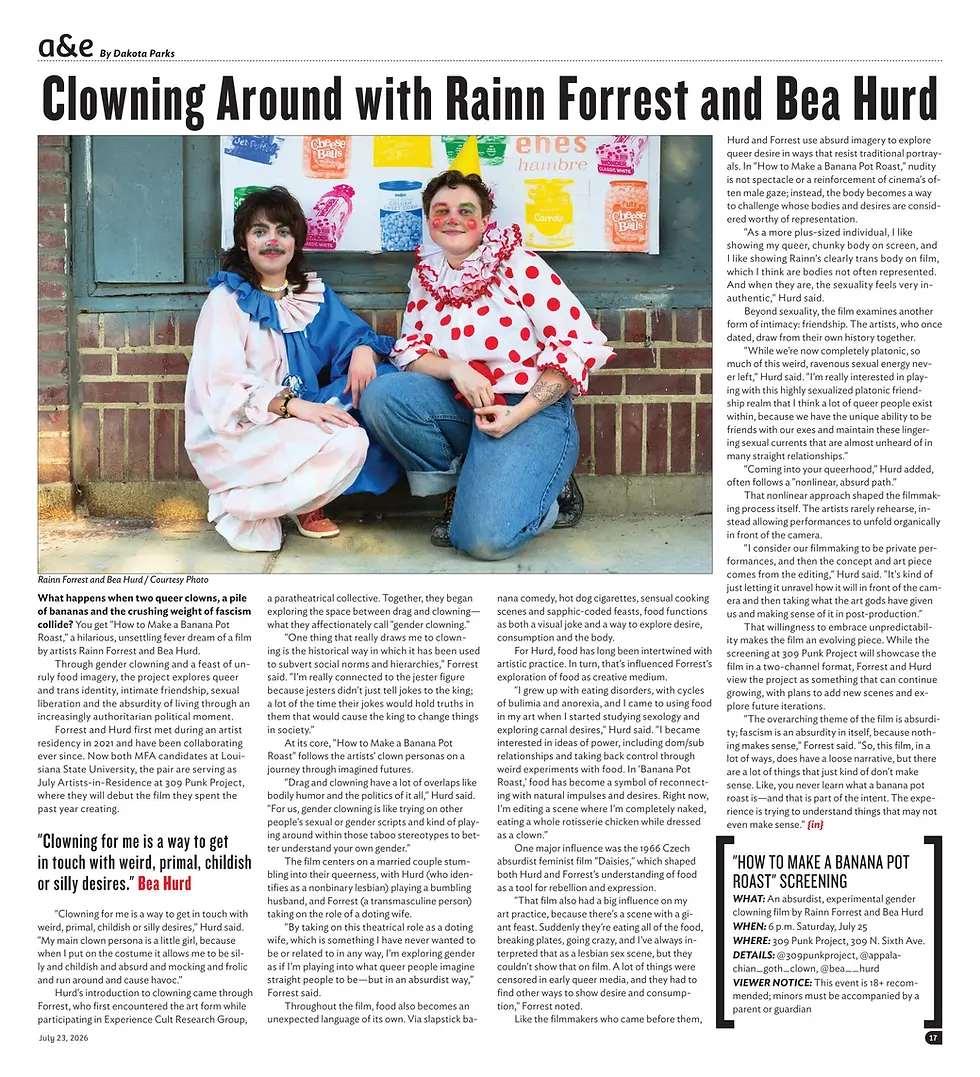
What happens when two queer clowns, a pile of bananas and the crushing weight of fascism collide? You get “How to Make a Banana Pot Roast,” a hilarious, unsettling fever dream of a film by artists Rainn Forrest and Bea Hurd.
Through gender clowning and a feast of unruly food imagery, the project explores queer and trans identity, intimate friendship, sexual liberation and the absurdity of living through an increasingly authoritarian political moment.
Forrest and Hurd first met during an artist residency in 2021 and have been collaborating ever since. Now both MFA candidates at Louisiana State University, the pair are serving as July Artists-in-Residence at 309 Punk Project, where they will debut the film they spent the past year creating.
“Clowning for me is a way to get in touch with weird, primal, childish or silly desires,” Hurd said. “My main clown persona is a little girl, because when I put on the costume it allows me to be silly and childish and absurd and mocking and frolic and run around and cause havoc.”
Hurd’s introduction to clowning came through Forrest, who first encountered the art form while participating in Experience Cult Research Group, a paratheatrical collective. Together, they began exploring the space between drag and clowning—what they affectionately call “gender clowning.”
“One thing that really draws me to clowning is the historical way in which it has been used to subvert social norms and hierarchies,” Forrest said. “I’m really connected to the jester figure because jesters didn’t just tell jokes to the king; a lot of the time their jokes would hold truths in them that would cause the king to change things in society.”
At its core, “How to Make a Banana Pot Roast” follows the artists’ clown personas as they move through a nonlinear journey of gender exploration, queer awakening and imagined futures.
“Drag and clowning have a lot of overlaps like bodily humor and the politics of it all,” Hurd said. “For us, gender clowning is like trying on other people’s sexual or gender scripts and kind of playing around within those taboo stereotypes to better understand your own gender.”
The film centers on a married couple stumbling into their queerness, with Hurd (who identifies as a nonbinary lesbian) playing a bumbling husband, and Forrest (a transmasculine person) taking on the role of a doting wife.
“By taking on this theatrical role as a doting wife, which is something I have never wanted to be or related to in any way, I’m exploring gender as if I’m playing into what queer people imagine straight people to be—but in an absurdist way,” Forrest said.
Throughout the film, food also becomes an unexpected language of its own. Via slapstick banana comedy, hot dog cigarettes, sensual cooking scenes and sapphic-coded feasts, food functions as both a visual joke and a way to explore desire, consumption and the body.
For Hurd, food has long been intertwined with artistic practice. In turn, that’s influenced Forrest’s exploration of food as creative medium.
“I grew up with eating disorders, with cycles of bulimia and anorexia, and I came to using food in my art when I started studying sexology and exploring carnal desires,” Hurd said. “I became interested in ideas of power, including dom/sub relationships and taking back control through weird experiments with food. In ‘Banana Pot Roast,’ food has become a symbol of reconnecting with natural impulses and desires. Right now, I’m editing a scene where I’m completely naked, eating a whole rotisserie chicken while dressed as a clown.”
One major influence was the 1966 Czech absurdist feminist film “Daisies,” which shaped both Hurd and Forrest’s understanding of food as a tool for rebellion and expression.
“That film also had a big influence on my art practice, because there’s a scene with a giant feast. Suddenly they’re eating all of the food, breaking plates, going crazy, and I’ve always interpreted that as a lesbian sex scene, but they couldn’t show that on film. A lot of things were censored in early queer media, and they had to find other ways to show desire and consumption,” Forrest noted.
Like the filmmakers who came before them, Hurd and Forrest use absurd imagery to explore queer desire in ways that resist traditional portrayals. In “How to Make a Banana Pot Roast,” nudity is not spectacle or a reinforcement of cinema’s often male gaze; instead, the body becomes a way to challenge whose bodies and desires are considered worthy of representation.
“As a more plus-sized individual, I like showing my queer, chunky body on screen, and I like showing Rainn’s clearly trans body on film, which I think are bodies not often represented. And when they are, the sexuality feels very inauthentic,” Hurd said.
Beyond sexuality, the film examines another form of intimacy: friendship. The artists, who once dated, draw from their own history together.
“While we’re now completely platonic, so much of this weird, ravenous sexual energy never left,” Hurd said. “I’m really interested in playing with this highly sexualized platonic friendship realm that I think a lot of queer people exist within, because we have the unique ability to be friends with our exes and maintain these lingering sexual currents that are almost unheard of in many straight relationships.”
“Coming into your queerhood,” Hurd added, often follows a “nonlinear, absurd path.”
That nonlinear approach shaped the filmmaking process itself. The artists rarely rehearse, instead allowing performances to unfold organically in front of the camera.
“I consider our filmmaking to be private performances, and then the concept and art piece comes from the editing,” Hurd said. “It’s kind of just letting it unravel how it will in front of the camera and then taking what the art gods have given us and making sense of it in post-production.”
That willingness to embrace unpredictability makes the film an evolving piece. While the screening at 309 Punk Project will showcase the film in a two-channel format, Forrest and Hurd view the project as something that can continue growing, with plans to add new scenes and explore future iterations.
“The overarching theme of the film is absurdity; fascism is an absurdity in itself, because nothing makes sense,” Forrest said. “So, this film, in a lot of ways, does have a loose narrative, but there are a lot of things that just kind of don’t make sense. Like, you never learn what a banana pot roast is—and that is part of the intent. The experience is trying to understand things that may not even make sense.”
“How to Make a Banana Pot Roast” Screening
WHAT: An absurdist, experimental gender clowning film by Rainn Forrest and Bea Hurd
WHEN: 6 p.m. Saturday, July 25WHERE: 309 Punk Project, 309 N. Sixth Ave.
DETAILS: @309punkproject, @appalachian_goth_clown, @bea__hurd
VIEWER NOTICE: This event is 18+ recommended; minors must be accompanied by a parent or guardian


